
Breakouts & Fakeouts — How to Reduce Traps
A trader-grade breakout checklist: closes, acceptance, retests, and why most breakouts fail near obvious levels.
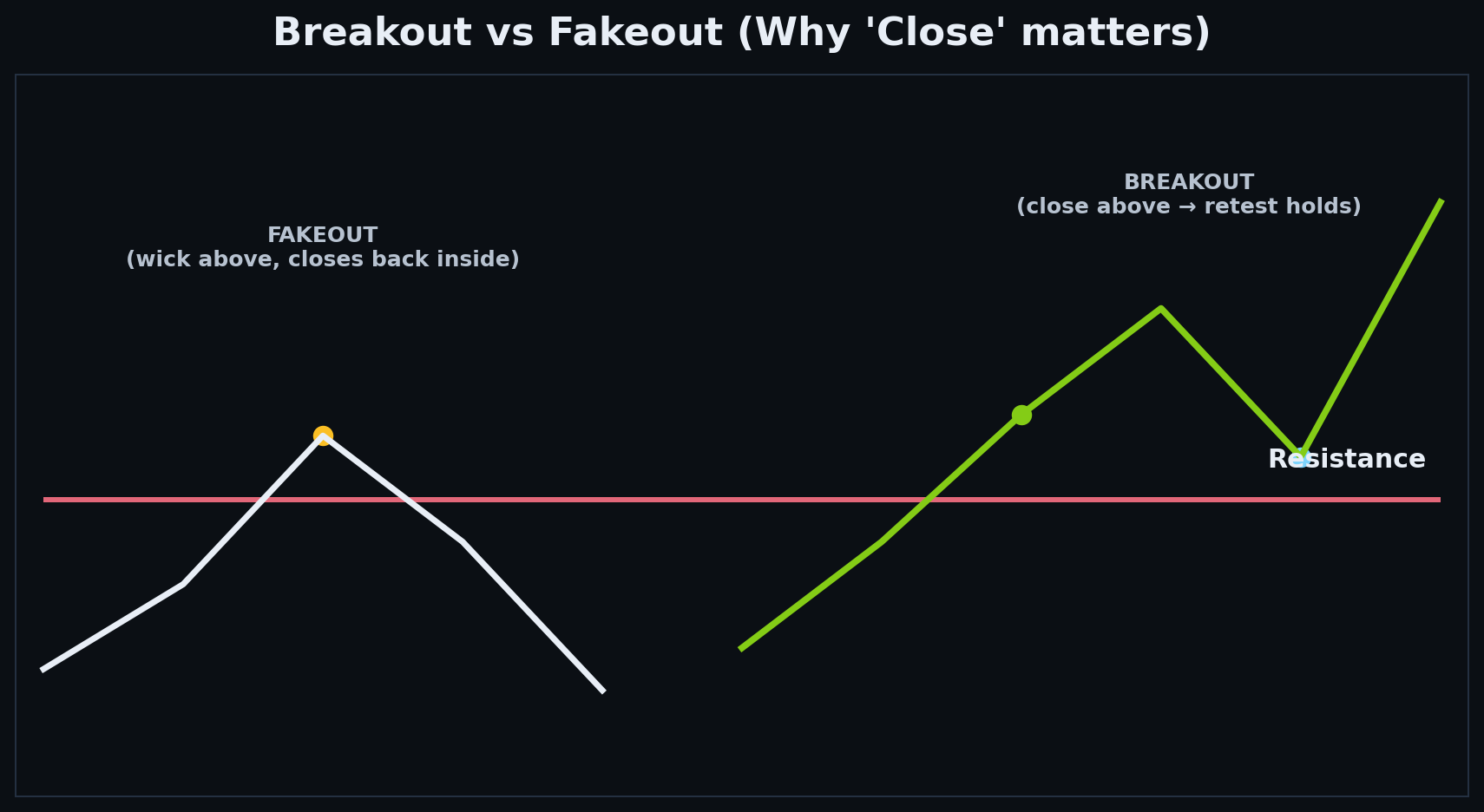
What a breakout is (structurally)
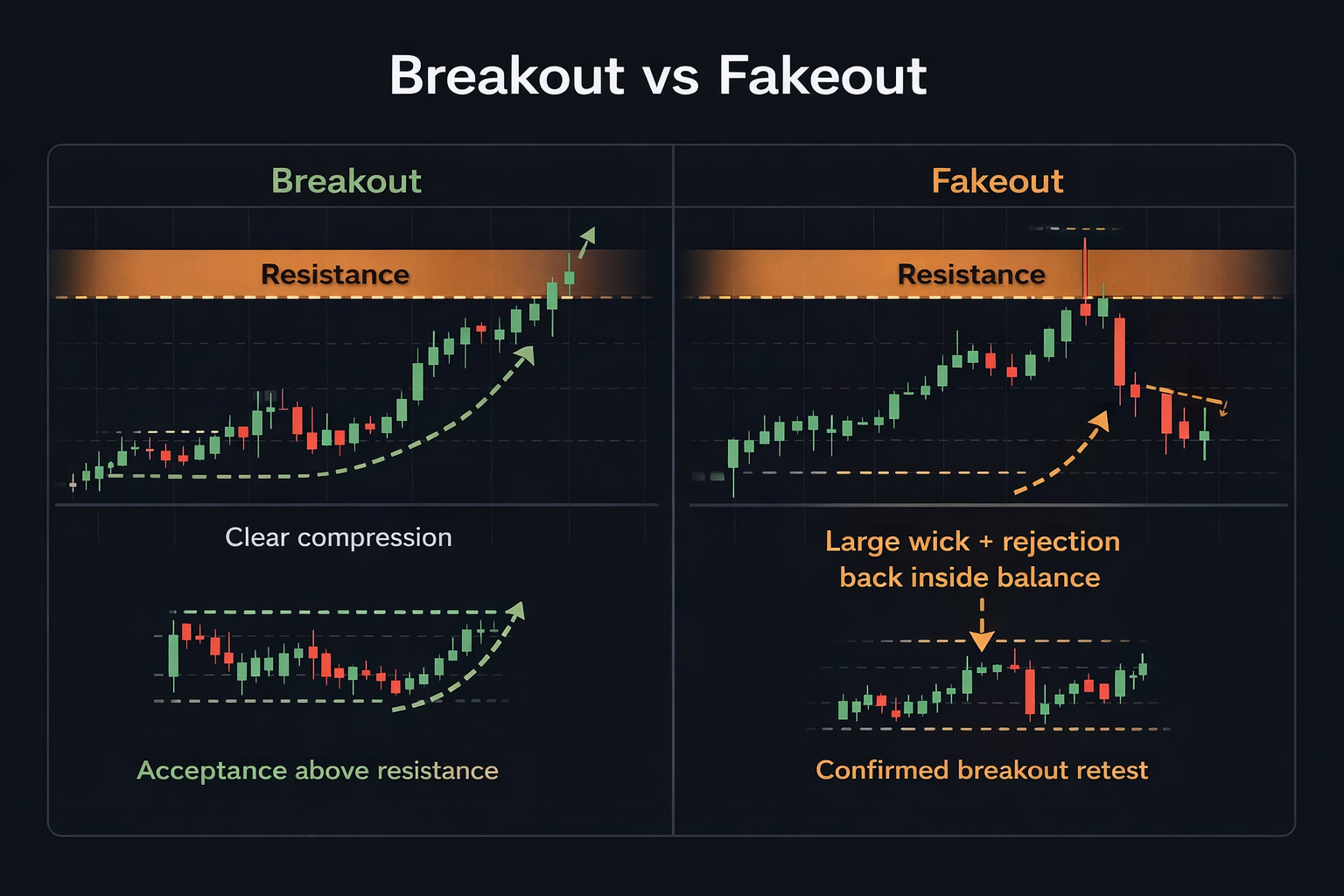
A breakout is more than price trading slightly above resistance for a moment. Structurally, a breakout means the market is attempting to leave a prior balance area and move into a new phase of acceptance. The best breakouts usually happen from clear levels that many traders are watching. When price escapes that level with conviction, the move can trigger fresh buyers, short covering and momentum participation.
- Breakout means price moves beyond a meaningful resistance zone.
- The best breakouts usually come from levels with repeated prior reactions.
- A real breakout usually includes acceptance, not just a temporary poke above the level.
- Breakouts often work best when they emerge from clean compression or range structures.
- The location of the breakout matters as much as the candle itself.
Why most breakouts fail
Many breakouts fail because the level was too obvious, the move was already extended, or there was nearby overhead supply immediately above the breakout zone. Some breakouts are simply liquidity events where price runs above the level, triggers breakout entries and stops for shorts, then falls back into the prior range. This is why patient traders focus on confirmation instead of reacting instantly to every break.
- Obvious crowded levels often attract false breakout behavior.
- Breakouts taken after extended moves usually carry worse reward-to-risk.
- Nearby resistance can limit follow-through even after a clean initial break.
- Some breakouts fail because the market never truly accepts above the level.
- Waiting for evidence usually reduces trap risk.
Acceptance vs rejection
The difference between a strong breakout and a weak one is often acceptance. Acceptance means price holds above the zone and begins treating it as support. Rejection means price briefly trades above resistance but quickly falls back inside the prior structure. A trader should care less about the first break itself and more about what price does immediately after the break.
- Acceptance means price holds above the level and uses it as support.
- Rejection means price breaks briefly but closes or trades back inside the old range.
- Acceptance usually includes follow-through, stable candles or a successful retest.
- Rejection often appears as fast failure after the initial breakout candle.
- Strong breakouts tend to look orderly after the break, not chaotic.
Retest logic
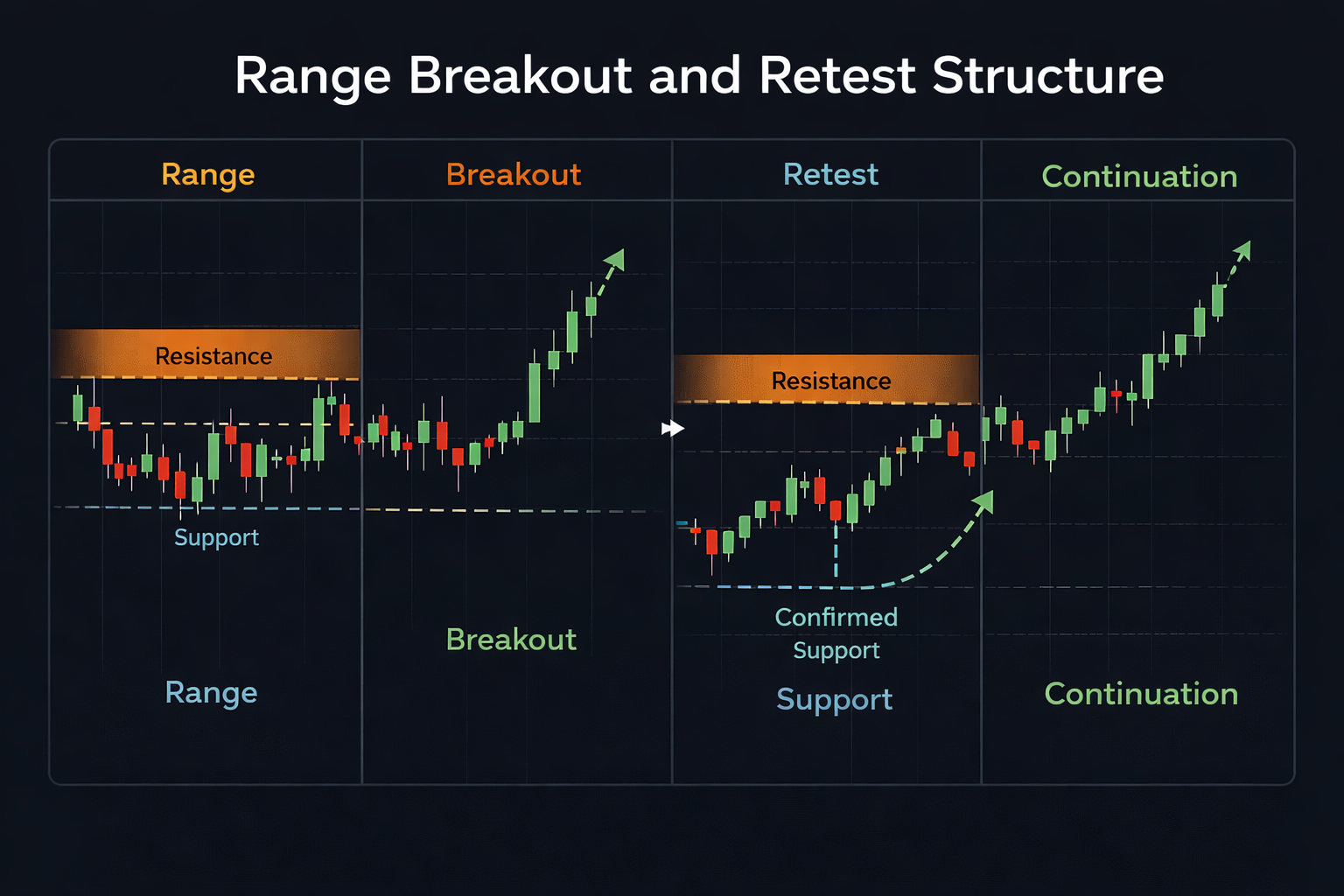
A retest can provide a second-chance entry after the initial break. In many cases, the retest is actually the cleaner trade because invalidation becomes easier to define. However, not every breakout retests. Strong momentum names may continue without looking back, while weaker moves often need to prove themselves with a successful revisit of the zone.
- A retest can offer a cleaner entry than chasing the first breakout candle.
- The retest often provides clearer invalidation below the reclaimed zone.
- Not every breakout retests, so context and trend strength matter.
- A successful retest often shows buyers stepping in near the old resistance.
- If the retest fails quickly, the breakout may have been weak from the start.
Range breakout vs trend breakout
Not all breakouts are the same. A range breakout happens when price leaves a sideways structure. A trend breakout may occur when price clears a continuation level inside an already rising trend. Range breakouts can start entirely new directional moves, while trend breakouts often continue existing momentum. Traders should understand which type they are dealing with because the expectations are different.
- Range breakouts often come from longer consolidation and can start new trends.
- Trend breakouts usually continue an existing directional structure.
- Range breakouts need room above the range to develop properly.
- Trend breakouts often work best when pullbacks remained constructive before the break.
- Knowing the breakout type helps set better expectations for follow-through.
False breakouts and liquidity traps
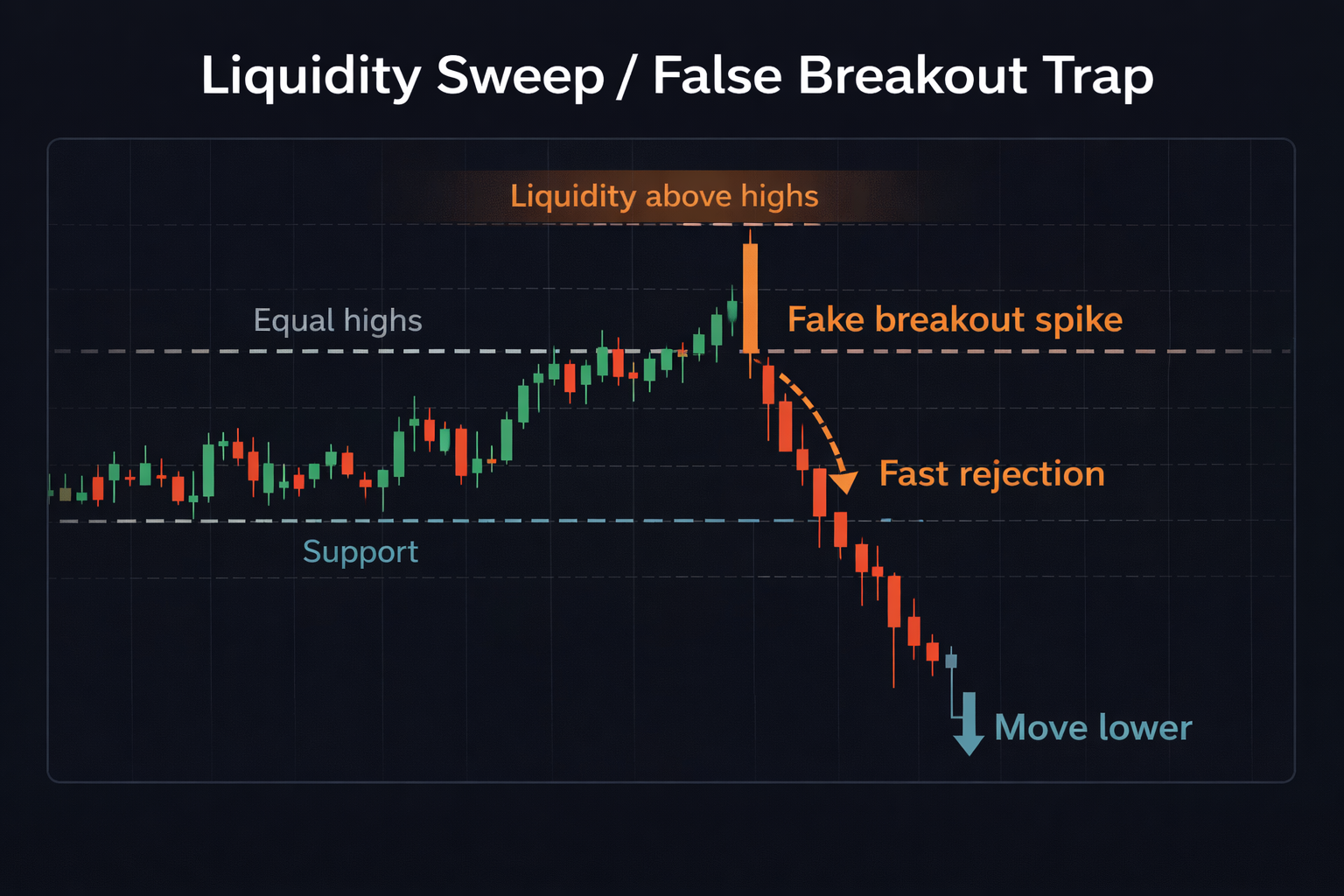
False breakouts are common because markets often move to where orders are concentrated. A level with many breakout traders above it and many stop orders from shorts can create a short-lived push higher. Once those orders are filled, price may reverse sharply. This is one reason why breakout trading without context can be dangerous. Many fakeouts are really liquidity events disguised as momentum.
- Some false breakouts occur because price is hunting liquidity around obvious highs.
- Breakout entries and short stops can fuel a temporary spike above resistance.
- If price cannot hold above the level, that spike may quickly fail.
- Fast return inside the prior structure is a classic warning sign of a trap.
- Liquidity events are more dangerous when the breakout has no room to run.
How traders actually plan breakout trades
Good breakout traders do not just buy every candle above resistance. They plan the trade around location, confirmation, invalidation and target. They ask whether the level is meaningful, whether there is space above, whether the move is extended, and where the trade idea fails. A breakout should fit into a full trade plan, not exist as an isolated signal.
- A trader may enter on the breakout, on the retest, or after acceptance is confirmed.
- Invalidation is often placed below the reclaimed zone or below the retest low.
- The next resistance area can help define the first target.
- Breakout quality improves when momentum, structure and volume all support the move.
- Good breakout trades usually begin from good locations, not emotional chasing.
Common mistakes
Most breakout mistakes come from impatience. Traders see price move above a level and immediately assume continuation is guaranteed. In reality, breakouts are context-dependent. Chasing the most obvious candle, ignoring nearby resistance, and entering after a move is already extended are among the most common ways traders get trapped.
- Buying the first breakout candle without checking acceptance.
- Ignoring nearby overhead resistance or supply.
- Chasing already extended moves.
- Treating every break above a line as a high-quality signal.
- Using no clear invalidation if the breakout fails.
Checklist
Before trading a breakout, it helps to run through a simple checklist. This reduces emotional entries and helps focus on whether the market is truly accepting above the level.
- Is resistance meaningful with multiple prior reactions?
- Did price close decisively beyond the zone or only poke above it?
- Is there immediate overhead supply or nearby resistance?
- Where is invalidation if the breakout fails?
- Is price already extended or is the move still early enough to offer good reward-to-risk?
Open the scanner, pick one symbol, and practice: mark zones, decide trend regime, and write one invalidation level. The goal is a repeatable process, not perfect predictions.