
Market Regimes — Trend vs Range
Understanding whether the market is trending or ranging is one of the most important trading skills.
Two core regimes
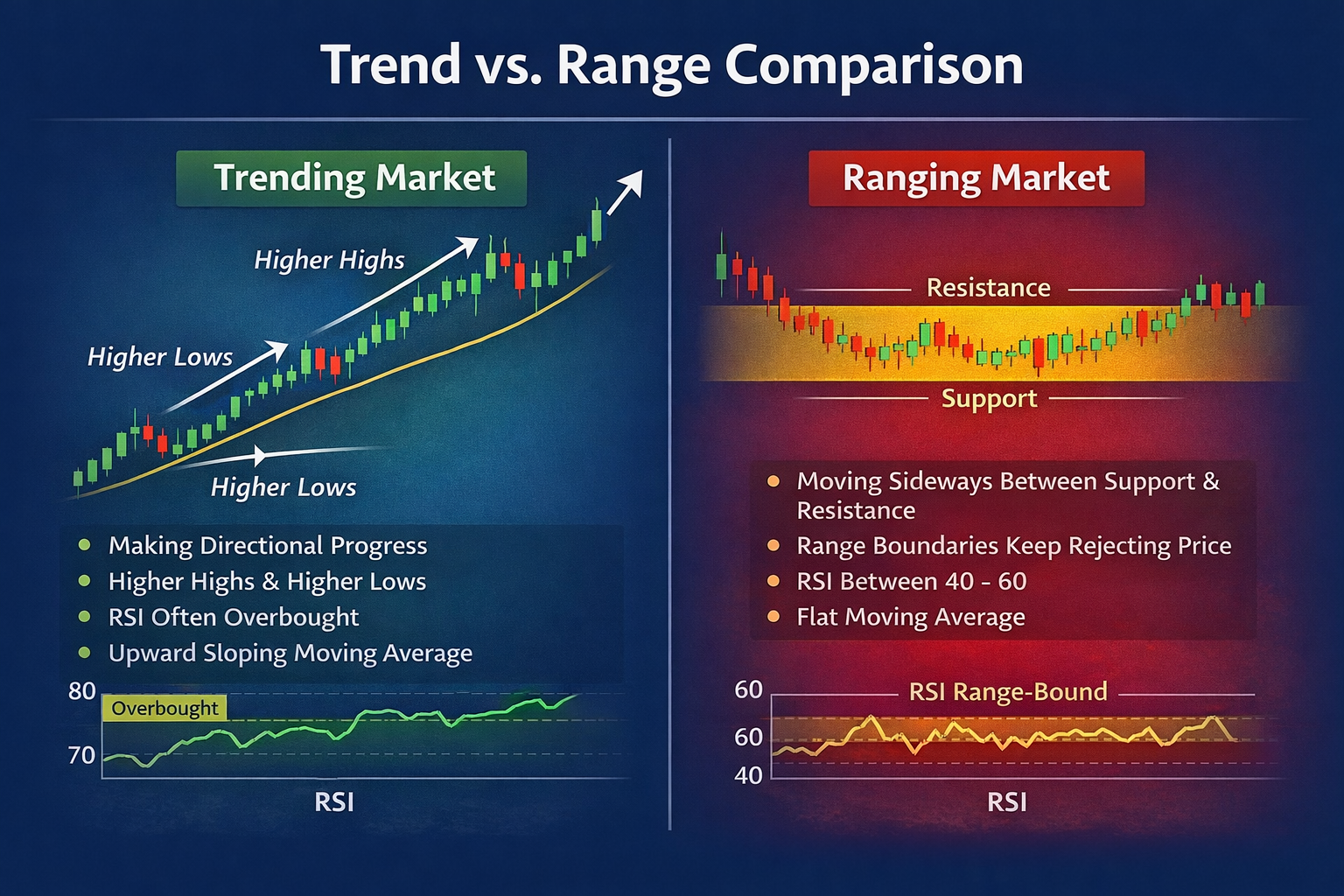
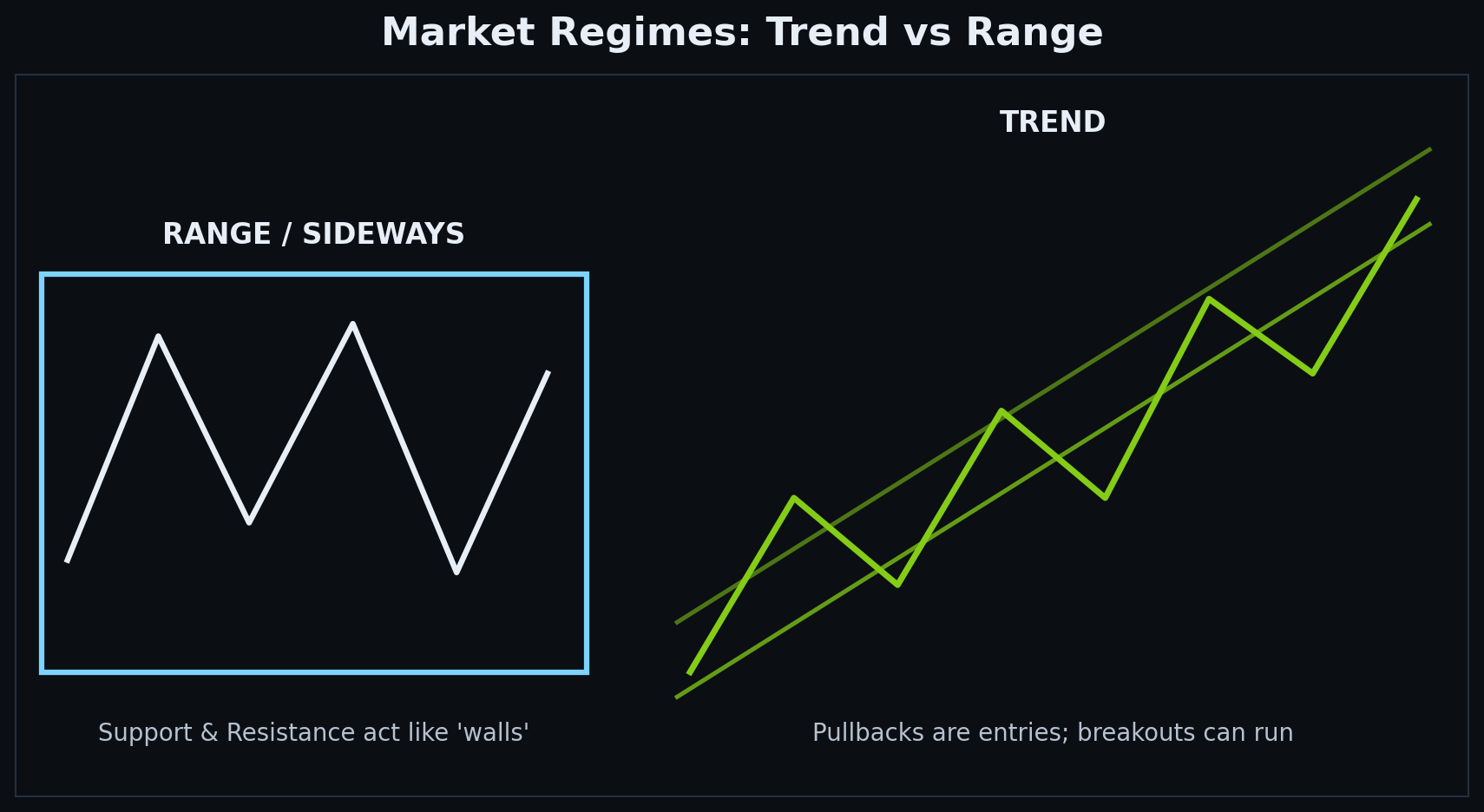
Most charts spend their time in one of two broad environments: trend or range. In a trend, price keeps making directional progress and structure remains biased in one direction. In a range, price rotates between boundaries without producing sustained follow-through. Many trading mistakes happen because the trader is using the wrong tactic for the current regime.
- Trend regime means price produces higher highs and higher lows in an uptrend, or lower highs and lower lows in a downtrend.
- Range regime means price oscillates between support and resistance without sustained directional progress.
- Recognizing the regime helps determine which trading tactics are more appropriate.
- A breakout trader and a range trader are often looking for very different behaviors.
- The same chart setup can work well in one regime and fail repeatedly in another.
Why regime recognition matters
Regime recognition matters because strategy quality depends on context. A pullback setup in a strong uptrend may be high quality, while the same-looking pullback inside a choppy range may just lead to noise. Likewise, breakout strategies tend to perform better in expanding directional conditions, while mean-reversion ideas tend to work better inside balanced ranges.
- Good setups often fail when used in the wrong regime.
- Trend-following tactics usually work best when price is already directional.
- Mean-reversion tactics usually work better when the market is balanced and rotating.
- Regime awareness improves trade selection, invalidation and expectations.
- The first question should often be: what kind of market am I trading?
How to recognize a trend
Trends usually show directional structure, directional moving averages and cleaner follow-through after pullbacks or breakouts. In an uptrend, higher lows keep holding and dips are often bought quickly. In a downtrend, rallies tend to fail beneath prior highs and pressure remains persistent. A trend does not need to be perfectly smooth, but it should show a clear directional bias over time.
- Trending markets often show directional moving averages and clear swing structure.
- Pullbacks tend to be shallow and find support quickly in strong trends.
- Breakouts are more likely to follow through in trending markets.
- Higher highs and higher lows suggest bullish trend behavior.
- Lower highs and lower lows suggest bearish trend behavior.
How to recognize a range
Ranges often appear when buyers and sellers are relatively balanced. Instead of making directional progress, price keeps reversing near similar boundaries. This usually creates repeated failures near resistance and repeated support reactions near the low of the range. In this environment, breakout signals become less reliable until the market clearly leaves the range.
- Ranges often show flat moving averages and repeated reversals near similar price zones.
- Breakouts frequently fail and return inside the range.
- Price rotates between support and resistance rather than trending.
- The middle of the range is usually the least attractive place to trade.
- Range behavior often feels noisy because directional follow-through is limited.
Trend tactics vs range tactics
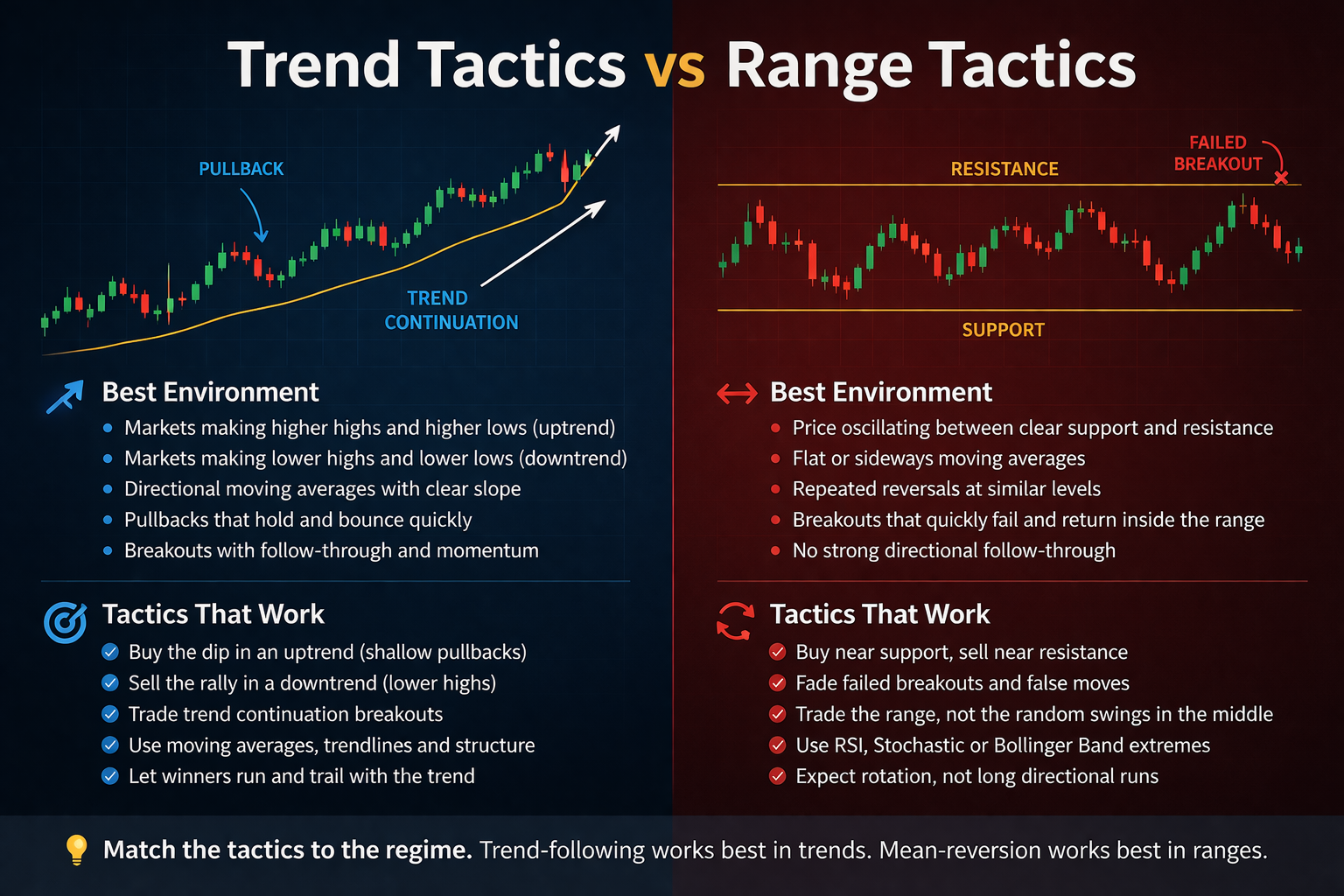
Different regimes call for different tactics. In a trend, traders often focus on continuation setups such as pullbacks, retests and trend-aligned breakouts. In a range, traders often focus on boundary reactions, failed breakouts or mean-reversion ideas near support and resistance. Problems begin when traders mix the two approaches without recognizing that the environment changed.
- Trend tactics often include buying pullbacks, trading continuation breakouts and following momentum.
- Range tactics often include buying near support, selling near resistance and fading failed breaks.
- Trend traders usually want follow-through; range traders usually expect rotation.
- The same indicator can behave differently depending on the regime.
- Expectations should match the environment rather than personal preference.
Transition from trend to range
A market does not remain trending forever. Sometimes a strong trend begins to lose momentum and shift into balance. This often happens when breakouts stop following through, pullbacks become deeper, and price starts reacting around similar horizontal zones. The chart may still look trend-like at first glance, but the internal behavior becomes less directional.
- Trend exhaustion often shows up as weaker follow-through after breakouts.
- Pullbacks may become deeper and more overlapping.
- Horizontal reactions may become more frequent than directional expansion.
- Momentum may flatten even if the prior trend is still visible on the chart.
- This transition often traps trend traders who expect the old behavior to continue.
Transition from range to trend
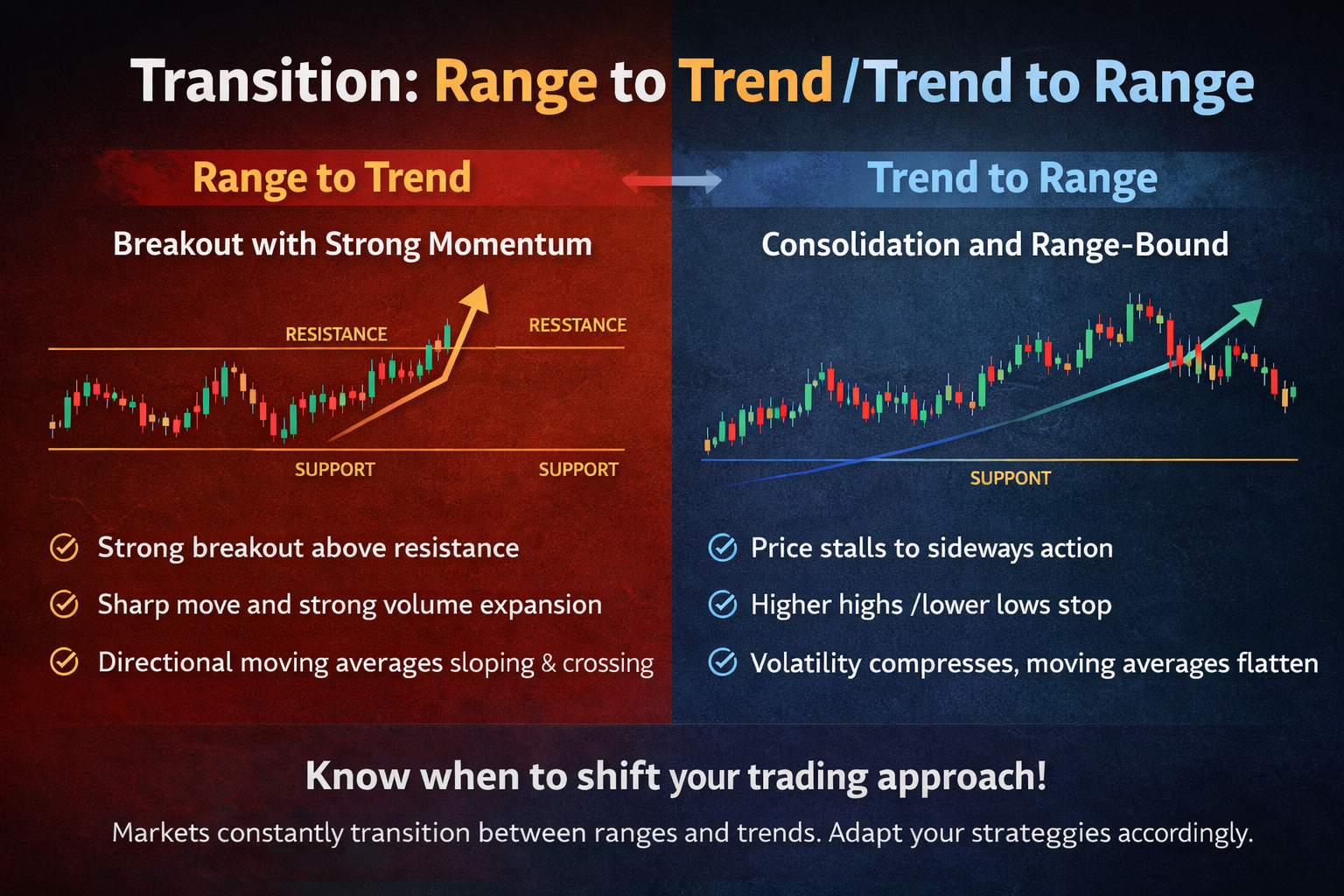
Ranges can eventually break into trends. The key difference is whether price truly leaves balance and begins holding outside the prior boundaries. A trend often starts when the market breaks out of the range, accepts above or below it, and then continues with directional structure. Traders should look for real acceptance rather than assuming every first break starts a trend.
- A range can transition into trend when price breaks the boundary and holds outside it.
- Acceptance matters more than the first breakout candle alone.
- A successful retest after a range breakout often strengthens the new trend case.
- The best new trends usually show structure, momentum and follow-through together.
- Failed range breaks are common, so patience matters.
Common mistakes
Most regime mistakes come from forcing a preferred strategy onto every chart. Some traders want every market to trend, while others keep fading moves that are actually directional. The best approach is to let the chart define the regime first, then choose the tactic that fits that environment.
- Applying a trend strategy inside a range.
- Fading strong trends as if they were normal range moves.
- Treating every breakout inside a range as the start of a major trend.
- Ignoring structure and relying only on one indicator.
- Refusing to adjust when the regime clearly changes.
Checklist
Before choosing a setup, it helps to confirm what kind of environment the market is in. This usually prevents many low-quality trades.
- Are moving averages sloping upward, downward or flat?
- Is price producing higher highs and higher lows, or just rotating sideways?
- Are reactions occurring repeatedly at similar zones?
- Am I applying a trend strategy inside a range, or a range strategy inside a trend?
- Has the market recently transitioned from one regime into another?
Open the scanner, pick one symbol, and practice: mark zones, decide trend regime, and write one invalidation level. The goal is a repeatable process, not perfect predictions.