
Risk Management — Protecting Capital First
A practical guide to position sizing, stop placement, risk-to-reward and expectancy so traders can survive losing streaks and compound good decisions over time.
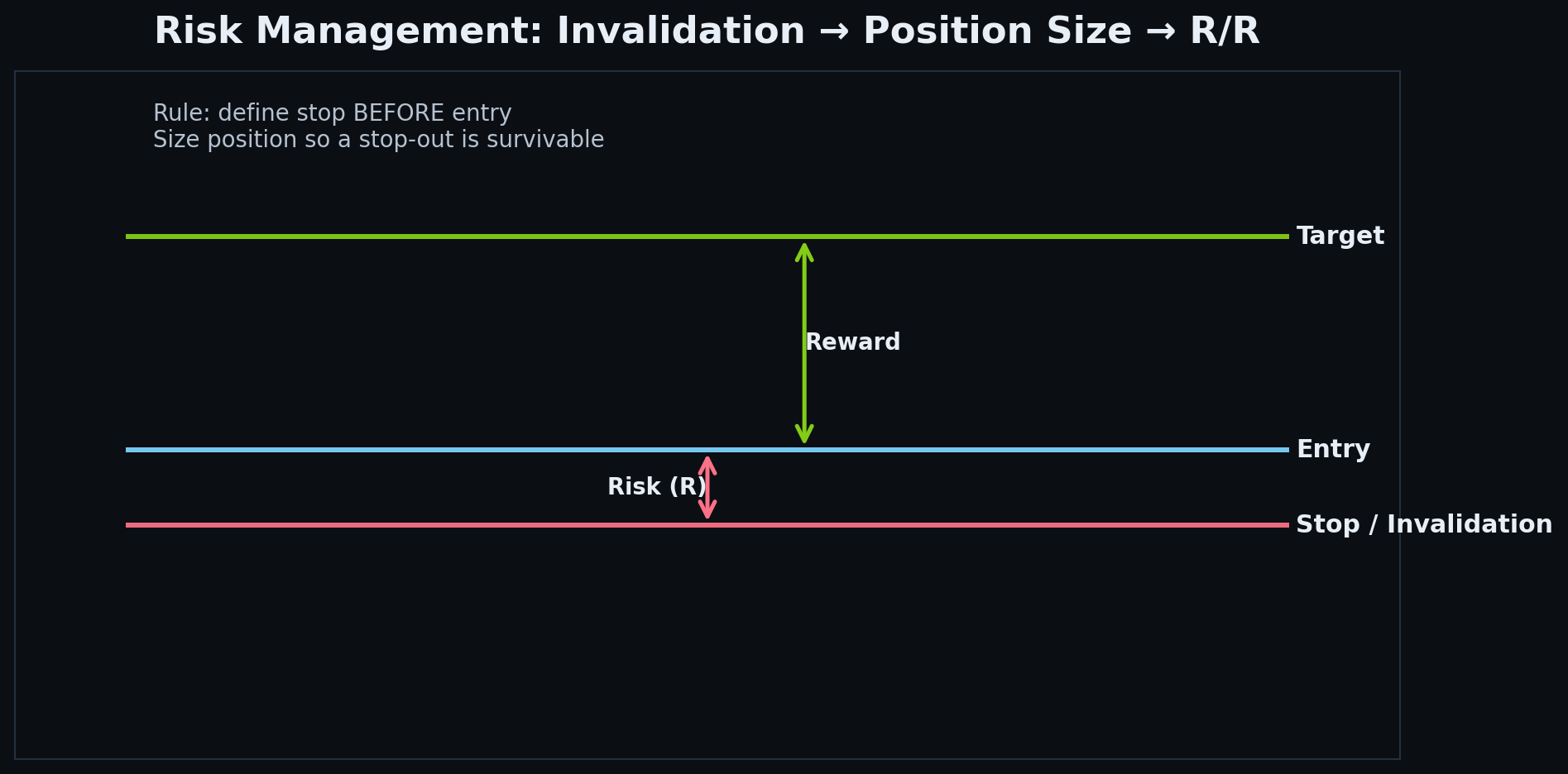
Why risk management matters more than entry
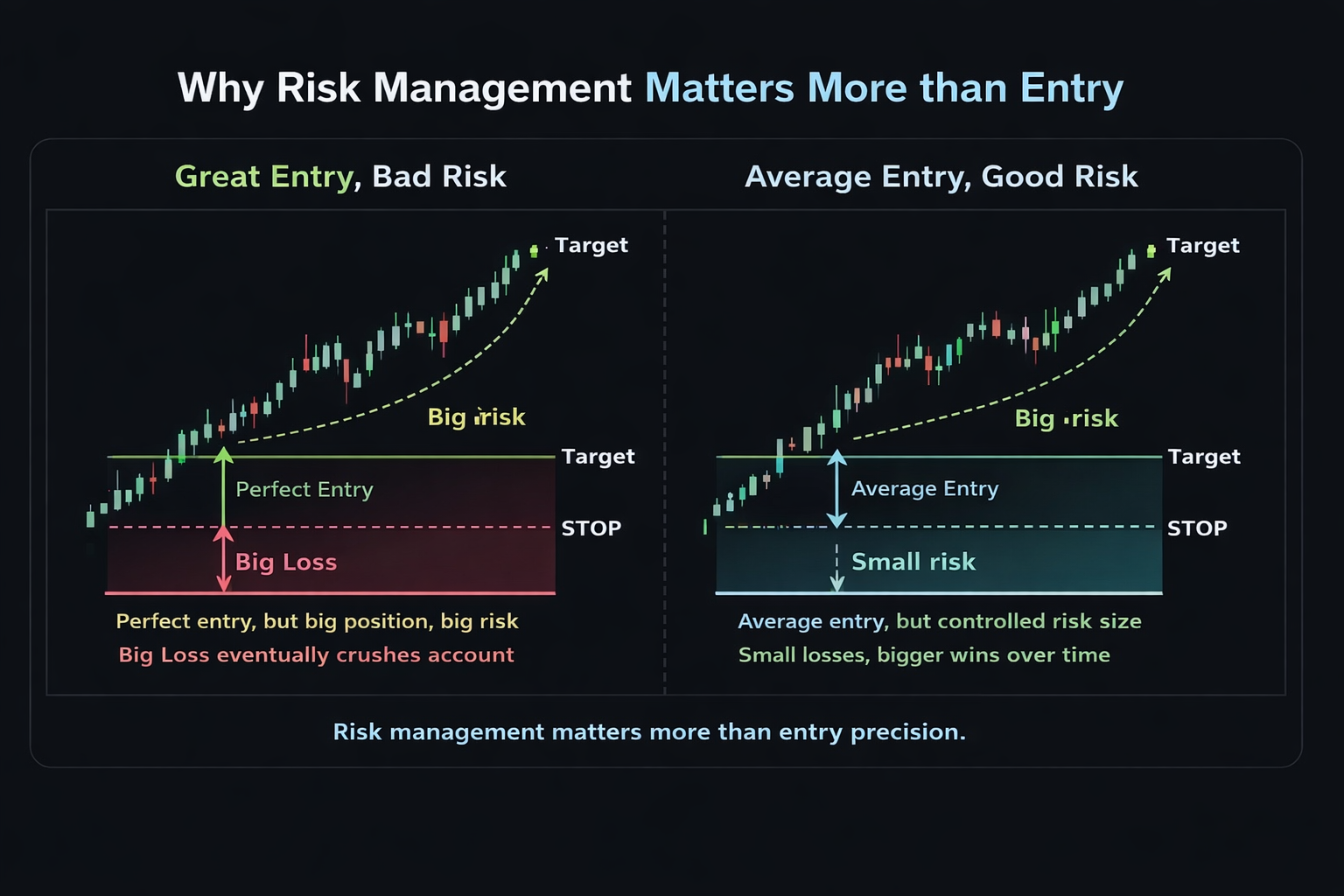
Many beginners spend most of their time searching for the perfect entry, the perfect indicator, or the perfect signal. Experienced traders usually learn the opposite lesson: entries matter, but risk management matters more. A good entry with poor risk control can still create serious damage, while an average entry with disciplined risk can still become part of a profitable process. Markets are uncertain, and no setup works every time. Because of that, the most important question is not only where to enter, but also what happens if the trade fails. Risk management is what turns trading from guessing into a sustainable decision-making process.
- Entries matter, but risk management matters more.
- Losses are unavoidable, but oversized losses are avoidable.
- A trading process survives because risk is controlled before the trade starts.
- Capital preservation is the foundation of long-term opportunity.
- The goal is not perfect prediction, but controlled outcomes.
Position size before conviction
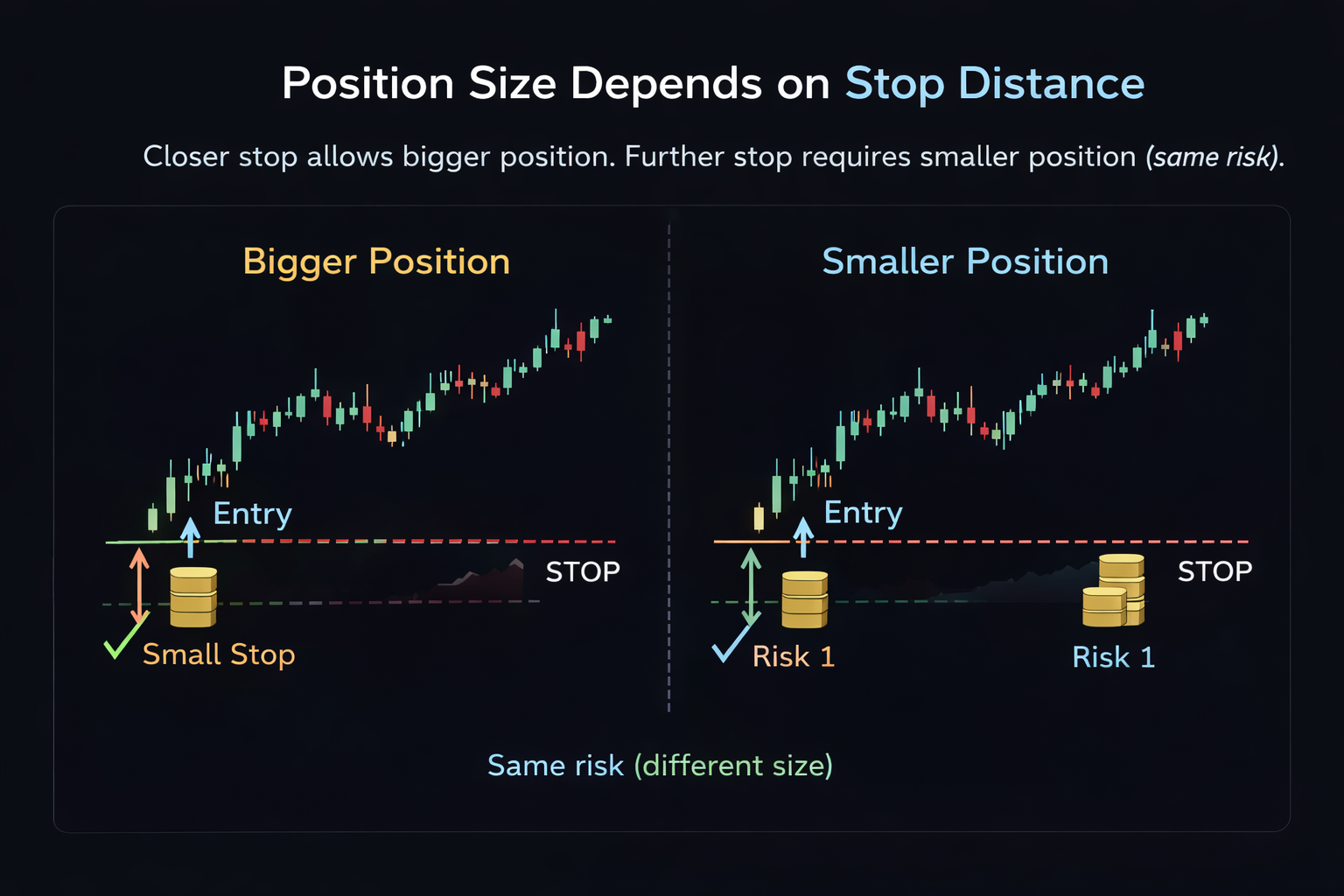
One of the biggest mistakes traders make is increasing size when they feel confident. Confidence can be useful psychologically, but it does not change the probability of a trade working. Position size should be based on risk, not conviction. In practice, this means deciding how much account capital can be lost if the trade fails, and then sizing the trade based on the distance to the stop loss. If the stop is wide, the position should usually be smaller. If the stop is tighter and still structurally valid, the position can be larger. This keeps risk consistent even when chart patterns differ.
- Position size should be based on risk, not excitement.
- A wider stop usually requires a smaller position.
- A tighter valid stop may allow a larger position.
- Consistent position sizing creates more stable results.
- Confidence should not override risk limits.
Fixed risk per trade
A simple and effective risk rule is to keep risk per trade relatively fixed. Many traders use a small percentage of account equity, such as 0.5%, 1%, or 2%, depending on their experience, market volatility, and strategy type. The logic is straightforward: trading is a long series of outcomes, not a single all-or-nothing event. A trader who risks too much on one idea may not survive a normal losing streak. A trader who risks a small, repeatable amount can stay in the game long enough for good process and positive expectancy to matter.
- Risk per trade should be small enough to survive losing streaks.
- Fixed risk creates consistency across many trades.
- Oversized risk usually turns normal drawdowns into major damage.
- Trading is a long sequence of decisions, not one big bet.
- Survival is part of edge.
Stop loss: invalidation, not emotion
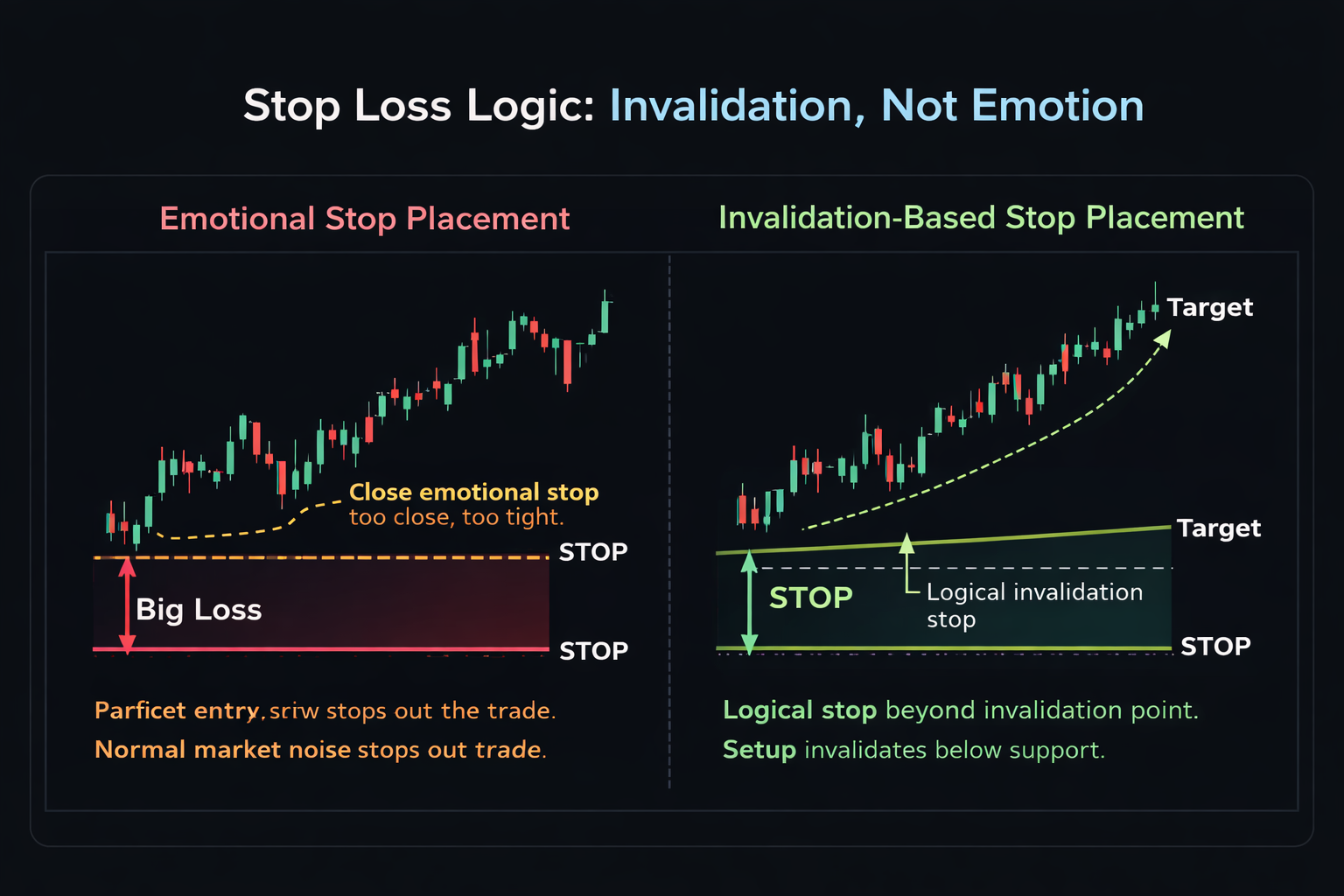
A stop loss should not be placed randomly, and it should not be based only on fear. A stop belongs where the trade idea is no longer valid. If the setup was based on a breakout, then failure back below the breakout area may invalidate the thesis. If the setup was based on a pullback into support, then a clean break below that support may invalidate the idea. Thinking this way helps traders stop using arbitrary stops and instead anchor risk to chart structure. A stop loss is not punishment. It is a predefined point where the market proves that the current idea is not working as expected.
- Stops should be based on invalidation, not discomfort.
- A structural stop is usually better than a random percentage stop.
- If the level breaks, the trade idea may no longer hold.
- Moving stops further away often increases emotional damage.
- A stop is information about the setup, not a personal failure.
Risk-to-reward and asymmetric trades
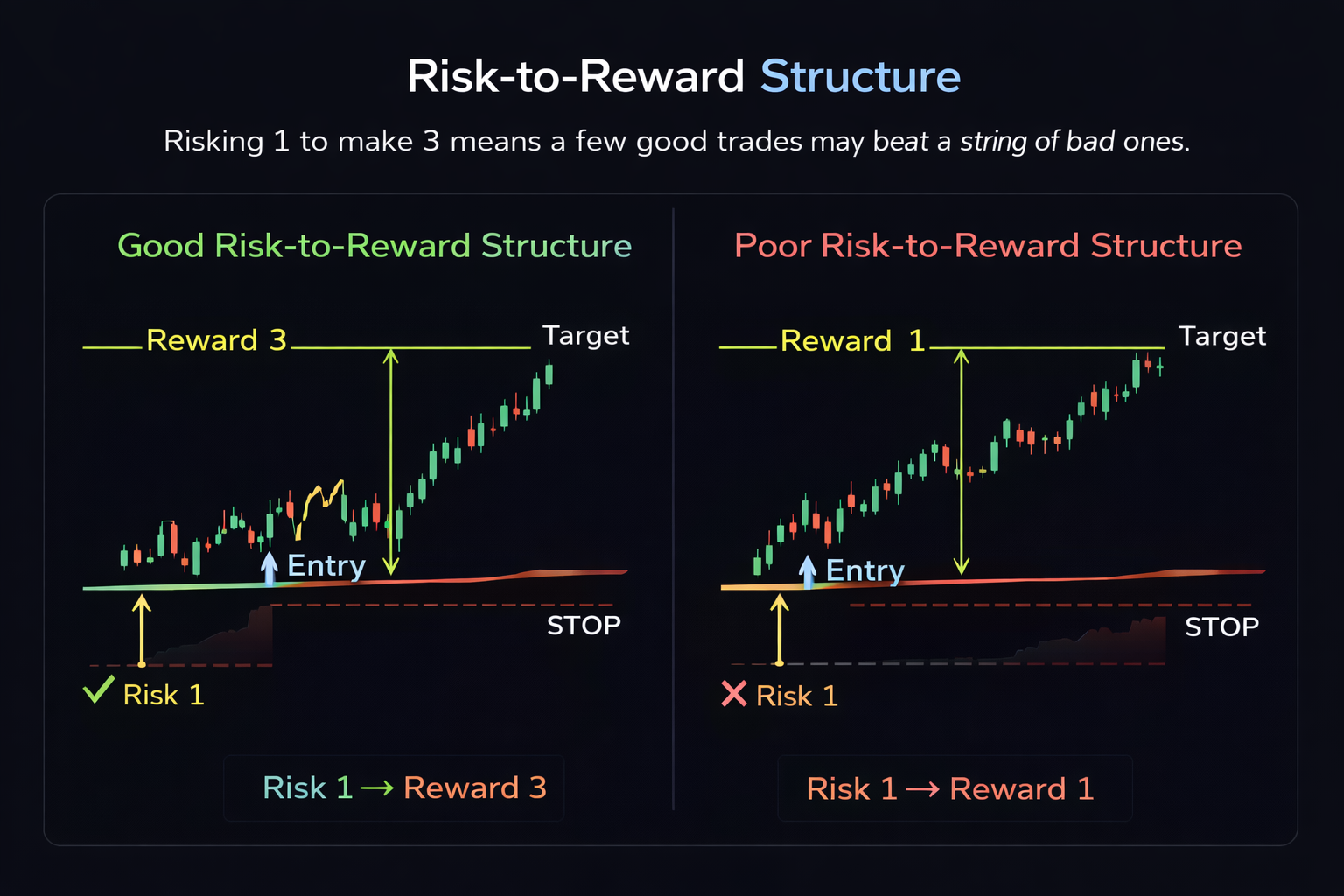
Risk-to-reward compares how much is being risked to how much could reasonably be made if the trade works. This concept matters because traders do not need to win all the time to be profitable. If a trader risks 1 unit to make 2 or 3 units, the math becomes more forgiving. These are often called asymmetric trades because the upside is meaningfully larger than the downside. Good trade location often improves this asymmetry. Entering too late usually compresses reward and expands risk, while entering near a logical level can improve the entire structure of the trade.
- Risk-to-reward matters as much as the entry signal itself.
- Asymmetric trades allow profitability with moderate win rates.
- Good location often improves reward relative to risk.
- Late entries usually make the trade less efficient.
- Large winners and controlled losers are a powerful combination.
Win rate vs expectancy
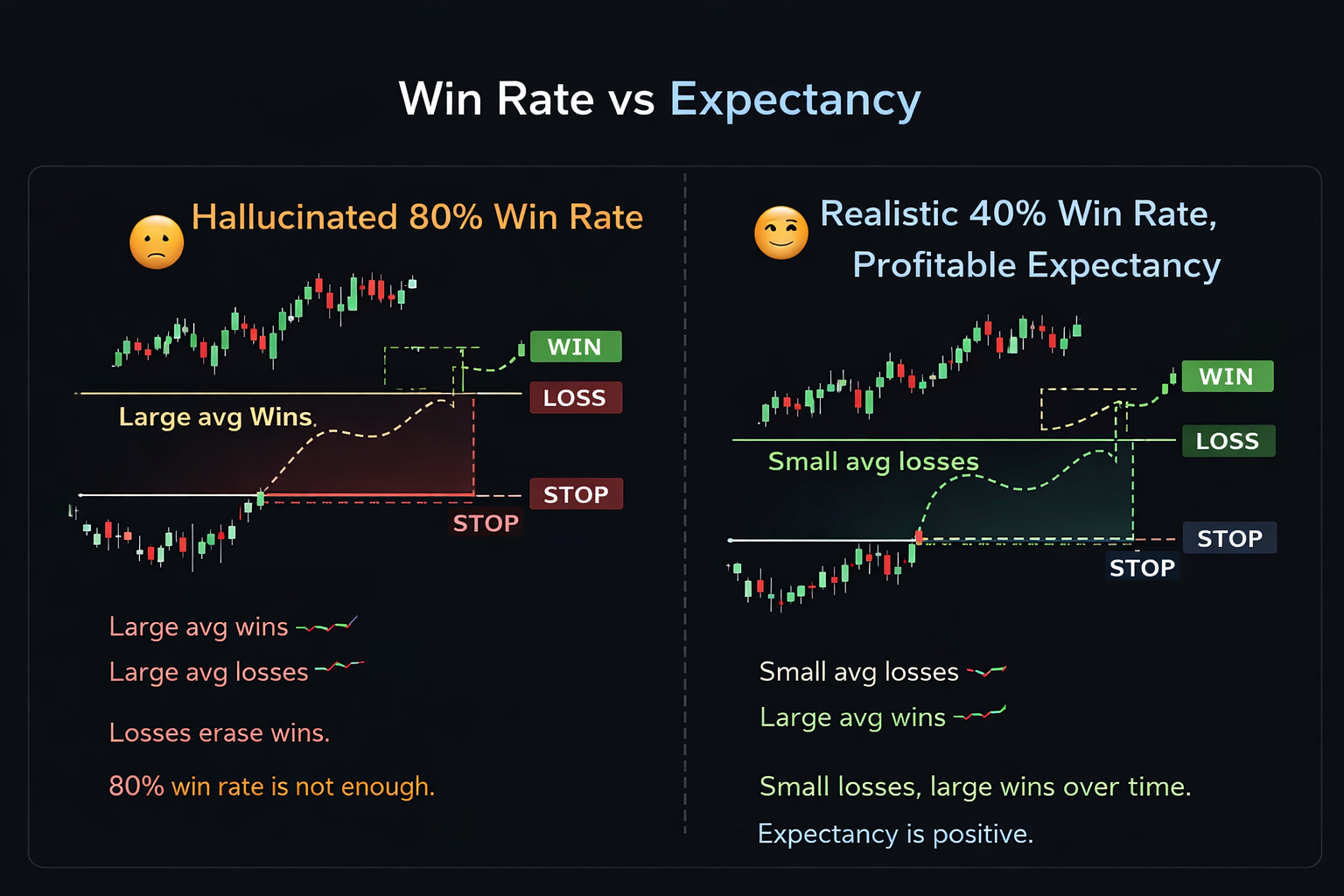
Many traders obsess over win rate because winning feels good emotionally. But win rate by itself says very little about whether a strategy actually makes money. A trader can win often and still lose money if the average loss is much larger than the average win. Another trader can win less often and still be profitable if winners are significantly larger than losers. What really matters is expectancy: the average amount a strategy is expected to make or lose over many trades. Expectancy combines win rate and payoff size, which is why risk management and trade quality matter more than trying to be right every time.
- A high win rate does not guarantee profitability.
- A lower win rate can still work with larger average winners.
- Expectancy combines win rate and payoff profile.
- Small losses protect the edge of a strategy.
- Trading is a probability game played over many repetitions.
Correlation risk and overexposure
A trader may think several positions create diversification, but in reality they may all be expressions of the same market idea. Buying multiple stocks from the same sector, or several names driven by the same macro theme, can create correlation risk. When that theme weakens, many positions may lose together. Good risk management therefore includes more than just risk per trade. It also includes total exposure, sector concentration, and how multiple positions may behave during the same market shock. Portfolio-level thinking helps prevent a trader from accidentally taking one idea five different ways.
- Several trades can be highly correlated even if the tickers differ.
- Sector concentration can magnify losses during one market move.
- Portfolio exposure matters in addition to single-trade risk.
- Too many similar positions reduce true diversification.
- Risk should be viewed across the whole book, not one chart at a time.
Scaling in and scaling out
Some traders use scaling as a way to reduce pressure and manage uncertainty. Scaling in means building a position in parts instead of all at once. This can be useful when a trader expects confirmation in stages, or when price may retest a level before moving. Scaling out means taking partial profits while keeping some exposure in case the trend continues. This can reduce emotional decision-making, especially in strong trends where a full exit might be premature. Scaling is not required for every strategy, but when used carefully, it can improve trade management and emotional discipline.
- Scaling in can reduce timing pressure.
- Scaling out can lock in profits while keeping upside exposure.
- Partial exits may reduce emotional stress.
- Scaling should still respect total risk limits.
- Not every strategy needs scaling, but it can be useful when planned.
Common mistakes
Most large trading damage comes from a small group of repeat mistakes. Traders often risk too much on one trade, widen stops instead of accepting invalidation, revenge trade after losses, or add exposure to correlated positions without realizing it. Others focus only on how often they win and ignore the size of their losses. These errors are usually emotional before they are technical. A trader rarely fails because one setup was imperfect. More often, failure comes from poor control over size, exposure, discipline, and process.
- Risking too much on one idea.
- Moving stops further away to avoid taking a loss.
- Overtrading after a winning or losing streak.
- Ignoring correlation and stacking similar positions.
- Chasing win rate instead of protecting expectancy.
- Trading without a clear invalidation level.
Checklist
Before entering a trade, it helps to ask a few direct questions. These questions force the trader to define risk before emotion takes over. If the answers are unclear, the setup may not be ready. The goal of a checklist is not to slow trading down for no reason. It is to prevent careless decisions that look small in the moment but become expensive over time.
- Where is the invalidation level?
- How much account capital is at risk on this trade?
- Is the potential reward large enough relative to the risk?
- Is this position correlated with other open trades?
- Does this trade fit the current market regime and my plan?
- Am I taking this trade because of structure, or because of emotion?
Open the scanner, pick one symbol, and practice: mark zones, decide trend regime, and write one invalidation level. The goal is a repeatable process, not perfect predictions.