
Volume and Price Action — Participation, Confirmation and Conviction
How traders use volume to confirm breakouts, continuation moves and reversals by understanding participation rather than treating volume spikes as signals.
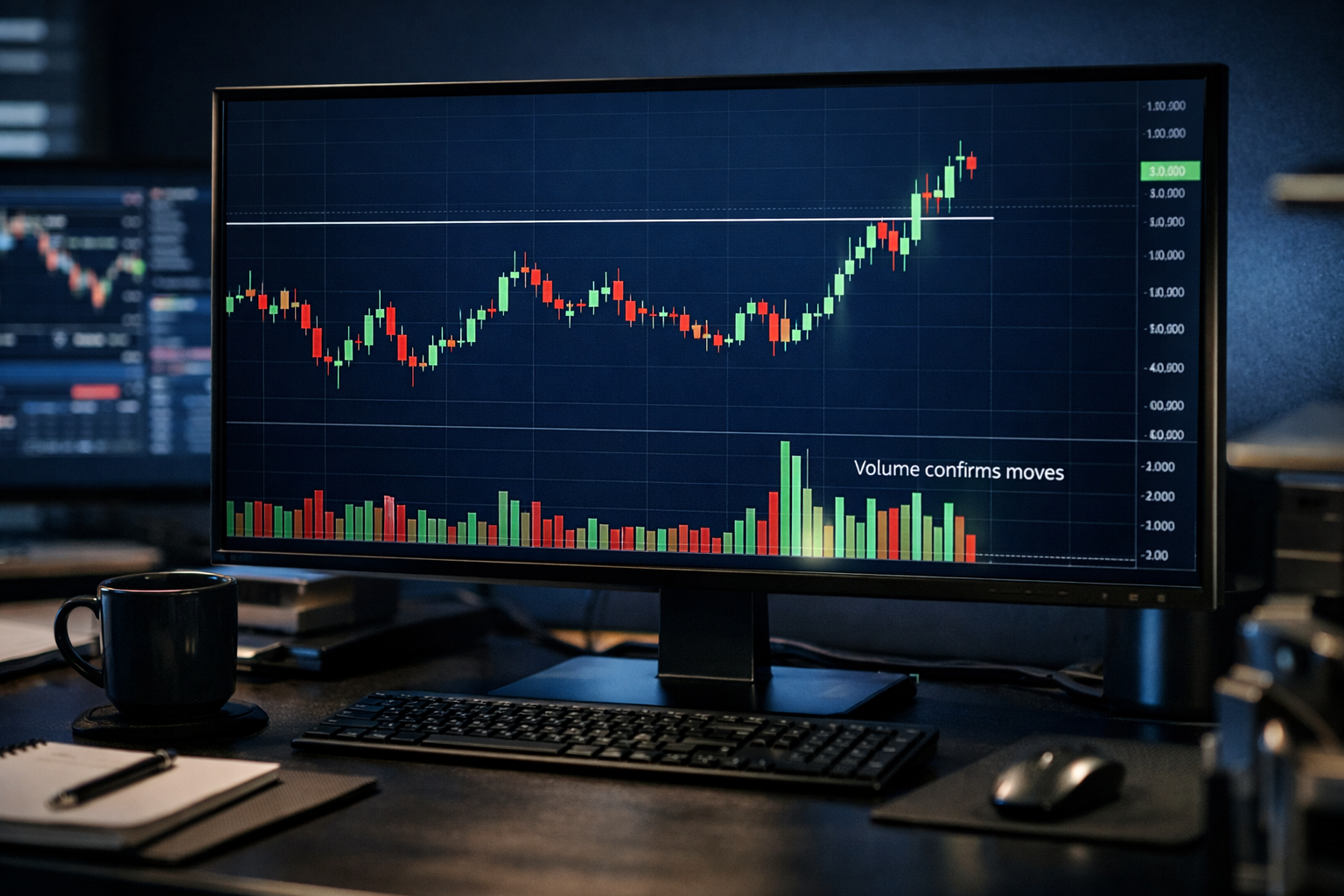
Why volume matters
Volume represents participation. It shows how many market participants are involved in a move and how much interest exists at certain price levels. Price can move on low volume, but moves supported by strong participation are usually more meaningful because more traders are accepting the new price. Volume does not predict direction by itself, but it often helps confirm whether a move has conviction or whether it is simply drifting with low interest.
- Volume represents participation and interest.
- High participation often strengthens a move.
- Low participation can make moves less reliable.
- Volume confirms moves more than it predicts them.
- Volume should be read together with price structure.
Volume during breakouts
One of the most common uses of volume is evaluating breakouts. When price breaks a resistance level with expanding volume, it often suggests acceptance and participation. When price breaks a level on very low volume, the breakout may be less reliable and more prone to failure. Volume does not guarantee a successful breakout, but strong participation often increases the credibility of the move.
- Breakouts with rising volume are often more credible.
- Low-volume breakouts may fail more often.
- Volume expansion can signal acceptance of new prices.
- Breakouts still need follow-through after the initial move.
- Structure and level quality still matter more than volume alone.
Volume during pullbacks
Volume can also help traders evaluate pullbacks inside trends. In a healthy uptrend, pullbacks often occur on lower volume because selling pressure is not aggressive. When pullbacks occur on very high volume, it may suggest stronger selling pressure and possible trend weakness. In downtrends, the opposite logic often applies. Understanding this behavior helps traders judge whether a pullback is normal or potentially problematic.
- Low-volume pullbacks can support trend continuation.
- High-volume pullbacks may signal stronger opposition.
- Healthy trends often show quieter pullbacks.
- Volume behavior helps evaluate trend quality.
- Pullback volume should be compared to impulse volume.
Volume spikes and exhaustion
Exceptionally high volume sometimes appears near the end of strong moves. These spikes can represent climactic behavior, where many traders enter or exit positions at the same time. This does not automatically mean a reversal will happen, but it can sometimes signal exhaustion, especially if the price move stalls shortly after the volume spike. Context is important, because volume spikes can also appear during strong continuation moves.
- Volume spikes can signal climactic activity.
- Exhaustion often appears after extended moves.
- Stalling after a volume spike can be informative.
- Volume spikes do not always mean reversal.
- Context and structure still matter.
Volume and trend strength
Volume patterns can also help traders judge the strength of a trend. Strong trends often show expanding volume during impulse moves and contracting volume during pullbacks. Weak trends often show inconsistent volume behavior or heavy volume during declines in an uptrend. Watching how participation behaves during different phases of a move can provide useful insight into trend quality.
- Strong trends often show expanding impulse volume.
- Pullbacks in strong trends often occur on lower volume.
- Weak trends may show heavy volume on declines.
- Volume behavior can reveal trend strength or weakness.
- Participation patterns matter more than single spikes.
Volume and key levels
Volume becomes especially useful near important technical levels such as support, resistance, breakout points or gap zones. Strong reactions with high volume near these levels can indicate that many participants are making decisions there. Low-volume reactions near important levels may be less meaningful. This is why many traders focus on volume behavior specifically around key areas rather than in the middle of a random price range.
- Volume is most useful near key levels.
- High-volume reactions at levels can be meaningful.
- Low-volume reactions may be less informative.
- Breakouts and rejections often show volume clues.
- Volume helps interpret reactions at support and resistance.
Common mistakes
Many traders misuse volume by expecting it to always confirm their bias. Volume should not be treated as a signal generator. A single volume spike does not guarantee continuation or reversal. Volume must be interpreted relative to recent activity, structure and location on the chart. Without context, volume data can easily be misinterpreted.
- Treating volume spikes as automatic signals.
- Ignoring price structure while focusing only on volume.
- Comparing volume across unrelated stocks.
- Expecting volume to predict direction by itself.
- Ignoring where volume appears on the chart.
How WOI Scanner uses volume context
The WOI Scanner uses volume as part of the broader technical context rather than as a stand-alone indicator. Volume behavior can help confirm breakouts, evaluate pullbacks and judge whether momentum is supported by participation. The goal is not to trade volume spikes, but to understand whether participation supports the price structure on the chart.
- Volume helps confirm breakouts and continuation.
- Volume helps evaluate pullbacks and reversals.
- Participation adds context to price structure.
- Volume is used as confirmation, not as a signal.
- Price structure still comes first in analysis.
Checklist
Before using volume in a trade idea, it helps to check whether participation actually supports the story that the chart structure is telling.
- Did volume expand in the direction of the move?
- Did volume contract during the pullback?
- Is the reaction happening near a key level?
- Is the volume unusually high or normal?
- Does price action confirm the message from volume?
- Is structure aligned with volume behavior?
Open the scanner, pick one symbol, and practice: mark zones, decide trend regime, and write one invalidation level. The goal is a repeatable process, not perfect predictions.